


Prof. Dr. Suat Karaküçük
Gazi University, Faculty of Sports Sciences
ksuatt@gmail.com
Today, various expressions are used to describe the physiological, psychological, and anatomical deficiencies or insufficiencies of individuals. The World Health Organization (WHO) has established a definition and classification based on disease consequences, focusing on the health aspect, and has addressed disability in three separate categories. Accordingly:
- Impairment: This is a loss or abnormality of psychological, physiological, or anatomical structure or function. It refers to disorders at the organ level. In terms of health, it expresses a deficiency or abnormality in physical structure and functions.
- Disability: This is any restriction or lack (resulting from an impairment) of ability to perform an activity in the manner or within the range considered normal for a human being. It refers to disorders at the individual level, expressing a limitation or insufficiency in performing an activity in a normal manner or within limits considered normal.
- Handicap: This is a disadvantage for a given individual, resulting from an impairment or a disability, that limits or prevents the fulfillment of a role that is normal (depending on age, sex, and social and cultural factors) for that individual (World Health Organization, 1994).
With a different approach, Marles explains the meanings of the words impairment, disability, and handicap used when defining “Disabled” as follows: According to Marles, impairment is a medical term indicating anatomical loss or loss of bodily function. Disability is the measurable functional loss resulting from the disorder. Handicap is a social result caused by social conditions and the environment that prevents a person from achieving their expected maximum potential (Fulcher, 2004).
In summary, according to the World Health Organization definitions: “Impairment is a functional damage, Disability is a limitation in normal activities, and Handicap is a social disadvantage” (Şahin, 2004).
However, in the light of all these technical explanations and classification approaches, it is understood that the expression “Individuals with Special Needs” or “Children with Special Needs” has recently come to the forefront and gained acceptance as a more inclusive and useful concept. Individuals needing special education are defined as individuals who have difficulties in adapting to social life and meeting their daily needs due to the loss of their physical, mental, spiritual, sensory, and social abilities to varying degrees, either congenitally or subsequently, and who need protection, care, rehabilitation, counseling, and support services (Öztürk, 2011).
To meet the developmental needs of individuals with special needs and to enable them to benefit from educational services, special tools, special methods, special programs, special education teachers, and special education environments are required. It is indisputable that physical education and sports practices to be implemented in these special education environments needed for individuals with special needs have a privileged place in the education and development of individuals (Özer, 2011).
Physical activity for individuals with special needs includes physical and motor fitness, basic motor skills and patterns, aquatic and dance skills, and individual and group games and sports. The targeted behaviors regarding the affective, psychomotor, and cognitive development of individuals with special needs participating in these activities are listed below:
- Affective Development: Having fun, achieving, coping with one’s disability, developing social competence (honesty, tolerance, cooperation).
- Psychomotor Development: Developing physical and motor fitness elements – Developing basic movement skills – Developing sports skills.
- Cognitive Development: Creating original responses when a movement problem is posed – Learning to imagine, adding new things to imagination, creating new games, dances, and movement sequences – Learning game strategies and rules (Özer, 2011).
Furthermore, Sherrill (1988, 2004) listed the more comprehensive and long-term goals of physical activity for individuals with special needs as follows:
| Order of Importance | Long-Term Goals |
| 1. Positive Self Concept | • Developing a positive self-concept and body image. • Increasing movement ability and body appreciation. • Learning to adapt to the environment and accepting limitations that cannot be changed. • Thus, they can progress toward self-actualization. |
| 2. Social Competence | • Learning appropriate social behaviors such as sharing and communicating. • Reducing social isolation. • Learning how friendship is established and developed. • Showing good self-control and sportsmanship in winning and losing situations. • Developing other skills necessary for success. |
| 3. Motor Skills and Patterns | • Learning basic motor skills such as running, catching, throwing, jumping, hopping, kicking a ball, and leaping in mature form. • Specializing in motor skills by participating in games, sports, dance, and water games. • Developing fine and gross motor coordination for play activities, self-care activities, and activities required at work and school. |
| 4. Physical and Motor Fitness | • Developing the cardiovascular system, maintaining ideal weight. • Increasing muscle strength, endurance, and flexibility. • Gaining proper posture habits. |
| 5. Perceptual Motor Function and Sensory Integration | • Developing visual, tactile, auditory, and kinesthetic (movement sensation) functions. • Developing academic learning through play and perceptual activities. • Developing cognitive, language, and motor functions. |
| 6. Leisure Skills | • Transforming what is learned in physical education activities into lifelong sports, dance, and water skills habits. • Recognizing community resources for recreation (leisure sports). • Expanding individual repertoire and refining skills in sports, dance, water, and group games. |
| 7. Relief of Tension1 | • Having fun, participating in recreation activities, being happy. Relieving tension in socially acceptable conditions. Reducing hyperactivity, learning to relax.2 • Developing a positive attit3ude towards physical education. |
Although there are many definitions of physical activity for the disabled (PAD) made by various authors, it is generally defined as an area of physical education, sports, and movement sciences for individuals who require adaptation to participate in physical activity (Doll-Tepper, 2007). While PAD mostly covers disabled individuals, it is also valid for elderly individuals, individuals with obesity, or individuals who have various limitations in participating in activity for many reasons (Sherrill, 2008).
When considered in terms of sports sciences, PAD science is defined as a field of research, theory, and practice for individuals of all ages who do not have sufficient power to access physical activity opportunities and rights equally or who are disadvantaged in terms of resources (Sherrill & Hutzler, 2008).
The concept used in our country as physical education for the disabled or physical activity for the disabled is used in international literature as “Adapted Physical Activity” or “Adapted Physical Education.” The concept of adapted physical activity or adapted physical education emerged for the first time in 1973 when the International Federation of Adapted Physical Activity was founded by Canadian and Belgian scientists (Özer, 2011).
Sherrill expresses adapted physical activity as coaching, training, or empowerment activities performed by professionals with the aim of achieving the physical activity goal of all individuals with movement and social-based limitations (Sherrill, 2004).
“Therapeutic Recreation” is also a widely used concept with its play, sport, and exercise dimensions, which takes place as a predominant form outside of social and artistic activity groups for individuals with special needs. Therapeutic recreation aims to enable the sick, elderly, and disabled to eliminate or reduce their physical, mental, intellectual, and social limitations and disadvantages, or to be in harmony with these problems, by having fun, playing, engaging, competing, and experiencing happiness through recreational activities specially designed for them, thereby sustaining a more independent and quality life. Thus, a process is created aimed at obtaining or maximizing purposeful efforts through a recreation experience (Karaküçük, 2012).
Sports therapy constitutes the upper component of concepts such as “physical education for the disabled,” “sports or physical activity for the disabled,” “Adapted Physical Activity” or “Adapted Physical Education” as found in international literature, “therapeutic recreation,” and “play.” The basic characteristic of the activities is “movement.”
Individuals with special needs often experience problems participating in regular exercise, physical activity, or sports practices without any adaptation. Accordingly, a number of adaptations must be made in programs for individuals with special needs to participate in physical education and derive benefits through these educational activities (Schultheis, Boswell & Decker, 2000).
Adapted physical activity education programs have the same goals as regular education programs; however, they are programs in which various adaptations have been made to meet the abilities and needs of individuals with special needs (Block, 2007).
For example, basketball is a general activity, while wheelchair basketball is an adapted activity. Similarly, Goalball, designed for visually impaired individuals, is an adapted model of football. Among the ways to make the activity suitable for the individual are: adjusting the speed of the activity to the individual, reducing the rules, using signs/cues, limiting the area, and using activity cards. Additionally, balloons, beach balls, audible balls, velcro balls and targets, tennis balls, hoops, trampolines, scooters, targets, ropes, balance beams, and gymnastics boxes are among the equipment that can be used during activity adaptation (Özer, 2011).
Participation in such programs prepared in line with the needs and developmental characteristics of individuals makes significant contributions to their multi-faceted development (Srinivasan et al., 2014; Movahedi, Bahrami, Marandi & Abedi, 2013; Sowa & Meulenbroek, 2012).
Sherborne Developmental Movement Education and the Sports Education Project for Autistic Individuals (OSEP) can be shown as examples of such education and programs. In these example applications, it is possible to see a wide variety of scientifically selected sports, games, and exercise examples suitable for the objectives, their application methods, and the qualities of the materials used.
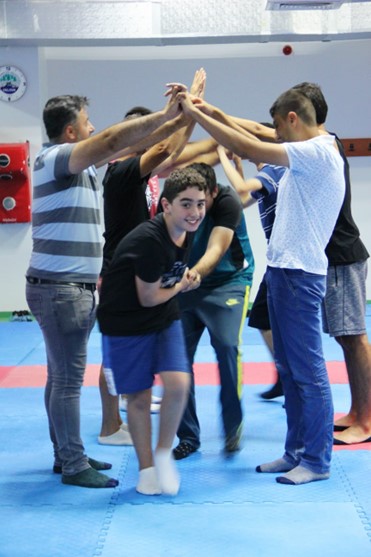
The OSEP-Autistic Individuals Sports Education Project, which has been carried out on a voluntary basis by the Gazi University Faculty of Sports Sciences Recreation Department since 2008, where university students and graduates take part actively and on a voluntary basis, can be counted among the examples given for the programs mentioned above. In this project, significant positive results are obtained with programs containing sports, games, and exercises applied to autistic individuals. These results are also demonstrated by scientific studies (Karaküçük, 2012).
Sherborne developmental movement education is a technique that directs individuals of all ages and different characteristics to gain self-confidence and establish relationships with themselves and others through movements found in human nature. The most important advantage of this technique is that it offers the individual a learning experience in an environment where there is no judgment or criticism, and everyone feels successful. Sherborne developmental movement technique provides teaching richness for educators at all levels and offers children the opportunity to discover themselves through movements.
Two main goals within the Sherborne Developmental Movement are self-awareness and awareness of others. Self-awareness is gained through movement experiences that help individuals concentrate. Thus, instead of a normal perspective, the aim is to become aware of what is happening to one’s own body through touching, listening, and feeling internal physical sensations. This helps reduce self-criticism and allows individuals to develop respect and confidence in themselves on both physical and emotional levels. The aim with awareness of others in the next step is to start learning to move and interact with others in a way that encourages further trust development and the establishment of positive relationships. These movement experiences ensure the individual is supported appropriately while encouraging them to discover their own unique creativity through shared creativity activities.
The fundamental philosophy underlying Sherborne education is as follows:
- It is success-based because, due to its approach, how the activity is done (the manner of doing it) is not important.
- It covers all ability areas starting from the lowest level (differentiated).
- Activities are ordered from simple to difficult.
- It provides a positive experience.
- It is a shared experience and everyone in the group is equal, thus contributing to the development of positive self-esteem.
- It is individual-centered and not prescriptive; ideas are taken from individuals and developed within the group, so there is flexibility.
- It encourages creativity.
- It develops confidence in oneself and others (https://www.sherbornemovementuk.org/).
Sherborne education is a good example of sports therapy. Particularly good results are obtained in sports education projects for autistic individuals where Sherborne movement education is included. Therefore, it is important to include Sherborne movement education in sports therapy programs for autistic individuals.
REFERENCES
- Block, M. E. (2007). A teacher’s guide to including students with disabilities in regular physical education (3rd ed.). Baltimore: Paul H. Brookes Publishing.
- Doll-Tepper, G. (2007). International Developments in Sports for Persons with a Disability. Sobama Journal, 12(1):7-12.
- Sherrill, C., & Hutzler, Y. (2008). Adapted Physical Activity Science. Borms, J. (Ed.) Directory of Sport Science. 5th ed. 90-103.
- Karaküçük, S. (2012). Terapatik Rekreasyon-Bir Örnek Uygulama: Osep (Otistik Bireyler Spor Eğitim Projesi), Gazi Kitabevi, Ankara.
- Fulcher, G. Disabling Policies? A Comparative Approach to Education Policy and Disability, Disability, Handicap and Life Chances Series, The Falmer Press, p. 22.
- Movahedi, A., Bahrami, F., Marandi, S. M., & Abedi, A. (2013). Improvement in social dysfunction of children with autism spectrum disorder following long term Kata techniques training. Research in Autism Spectrum Disorders, 7(9), 1054-1061. http://dx.doi.org/10.1016/j.rasd.2013.04.012
- Özer, S. D. (2011), Engelliler İçin Beden Eğitimi ve Spor, (4. Baskı) Ankara: Nobel Yayınları.
- Öztürk, M. (2011). Türkiye’de Engelli Gerçeği. Retrieved August 07, 2013 from http://emusiad.org/img/arastirmalaryayin/pdf/turkiyede%20engelli%20gercegi.pdf, İstanbul, Müsiad Yayınları.
- Schultheis, S. F., Boswell, B. B., & Decker, J. (2000). Successful physical activity programming for students with autism. Focus on Autism and Other Developmental Disabilities, 15(3), 159-162. http://dx.doi.org/10.1177/108835760001500306
- Sherrill, C., Ruda, L.: Leisure Interest and Practices of Mentally Retarded Adults, Parks and Recreations, 12 (11), 30-33, 1988.
- Sherrill, C. (2004). Adapted physical activity, recreation and sport. New York: McGraw-Hill.
- Sherrill, C. (2007). The Passion of Science: Research and Creativity in Adapted Physical Activity. Sobama Journal. 12(1): 1-5.
- Sowa, M., & Meulenbroek, R. (2012). Effects of physical exercise on autism spectrum disorders: A meta analysis. Research in Autism Spectrum Disorders, 6(1), 46-57. http://dx.doi.org/10.1016/j.rasd.2011.09.001
- Srinivasan, S. M., Pescatello, L. S., & Bhat, A. N. (2014). Current perspectives on physical activity and exercise recommendations for children and adolescents with autism spectrum disorders. Physical Therapy, 94(6), 1-46. http://dx.doi.org/10.2522/ptj.20130157
- Şahin, H. (2004), Engellilik Kimin Sorunu? Bireyin mi, Toplumun mu?, T.C. Başbakanlık Özürlüler İdaresi Başkanlığı Yayınları, Öz-veri Dergisi, Eylül 2004, Cilt 1,(1), p. 49.
- WHO, (1994). Community-Based Rehabilitation and The Health Care Referral Services a Guide for Programme Managers Rehabilitation.
- https://apens.org
- https://ifapa.net
- https://www.sherbornemovementuk.org/